


Drama templates that speed up structure, rhythm, and consistency per episode
Short drama templates you can use immediately: a twelve-episode frame with the act turns already marked, two kinds of template, and which parts must change for every title.
A template is not a shortcut around writing. It is a way of not re-deciding the same structural questions on every title, so your effort goes into content instead of scaffolding.
The danger is copying too much. A template that carries the setting and the conflict along with the frame produces titles that feel identical, and that is exactly the pattern audiences and search engines both notice.
This page separates what should stay from what must change, and shows how a single three-act frame serves very different genres by changing only what fills the turns.
The key points on this page
- A twelve-episode frame with three act turns whose positions are already marked.
- Two kinds of template that do not substitute for each other: structure and beat.
- Which parts stay fixed and which must be replaced for every title.
- How to fit the same frame to romance, thriller, horror, and comedy.
- The signs a template is constraining the story rather than helping it.
The twelve-episode frame and where the turns land
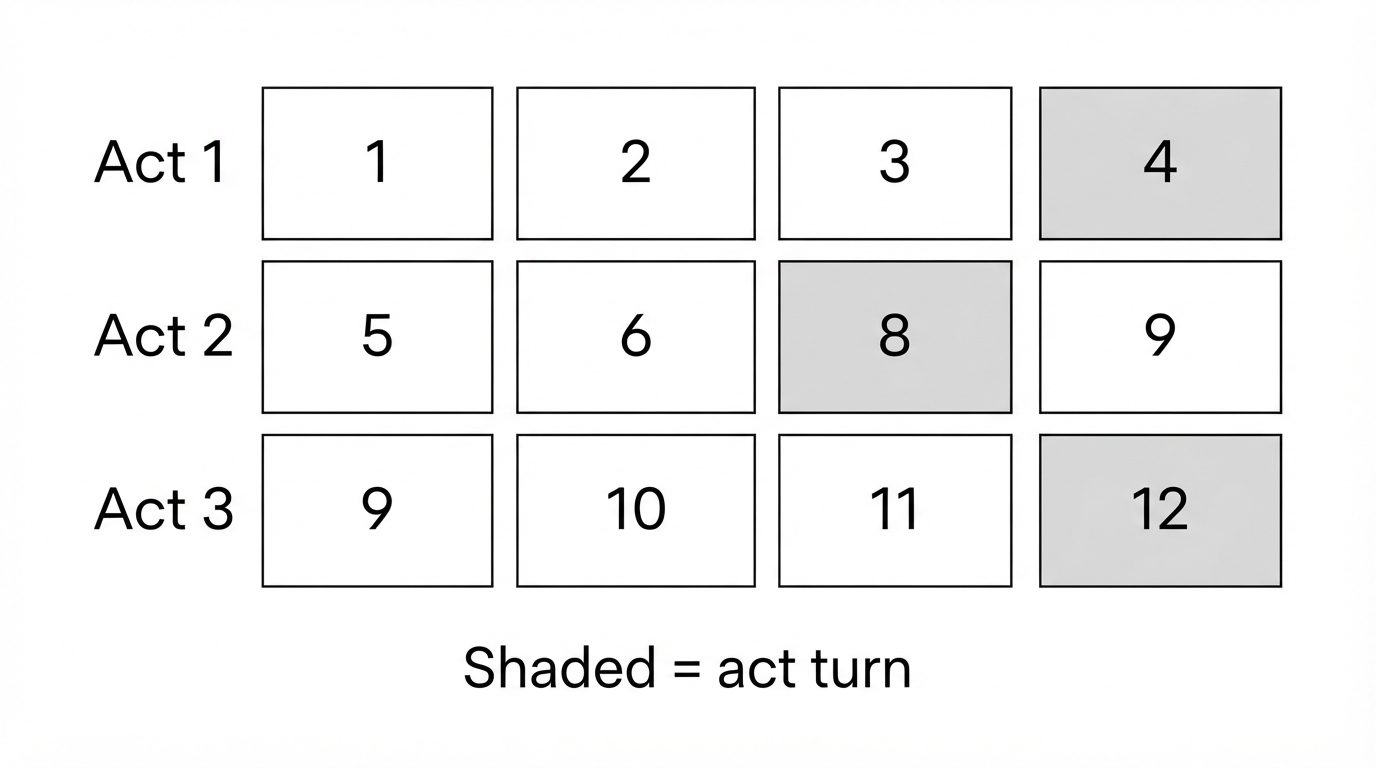
The frame that most often works for short drama divides twelve episodes into three acts of four. What makes it useful is not the division but marking the turns at episodes four, eight, and twelve.
Episode four closes the first act with a decision that cannot be taken back. Episode eight is the character's lowest point, when that decision claims its cost. Episode twelve is the payment, when the character accepts or settles the price.
Because the positions are fixed, intensity can be planned calmly. The other eight episodes do not need to match those three, and should not, so the turns feel distinct.
The frame still applies to longer titles. For forty episodes, repeat the pattern: three large turns remain, with smaller turns between them.
Two kinds of template that get confused
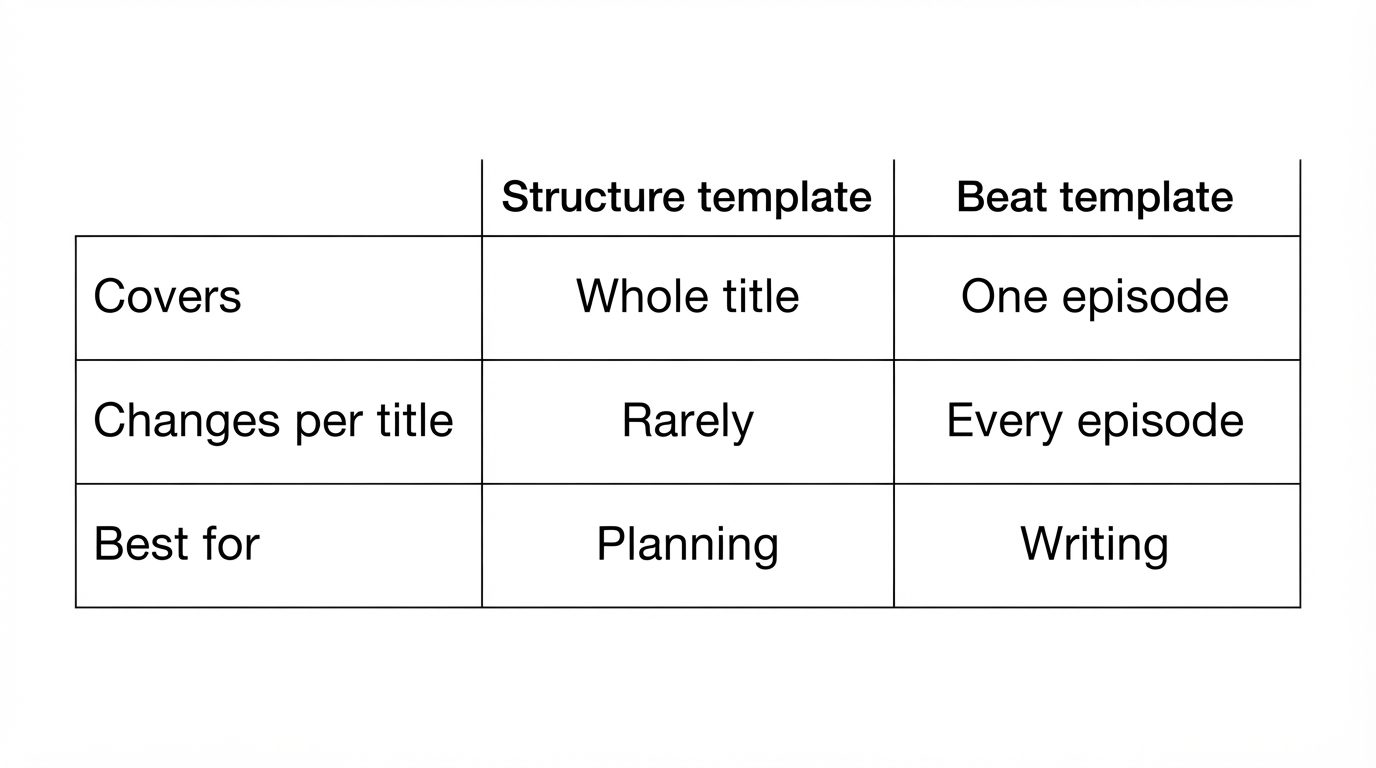
A structure template governs a whole title: how many episodes, where the turns fall, and what must happen in each act. It rarely changes between titles, and that is precisely its value.
A beat template governs one episode: how to open, where the turn sits, and how to cut. It changes almost every episode because it adapts to content.
The common error is using a structure template to write an episode, or the reverse. The first produces episodes that read like summaries; the second produces a title with no direction even when individual episodes are good.
Use them at different stages. The structure template is applied once per title; the beat template is applied repeatedly while writing.
What stays and what must be replaced
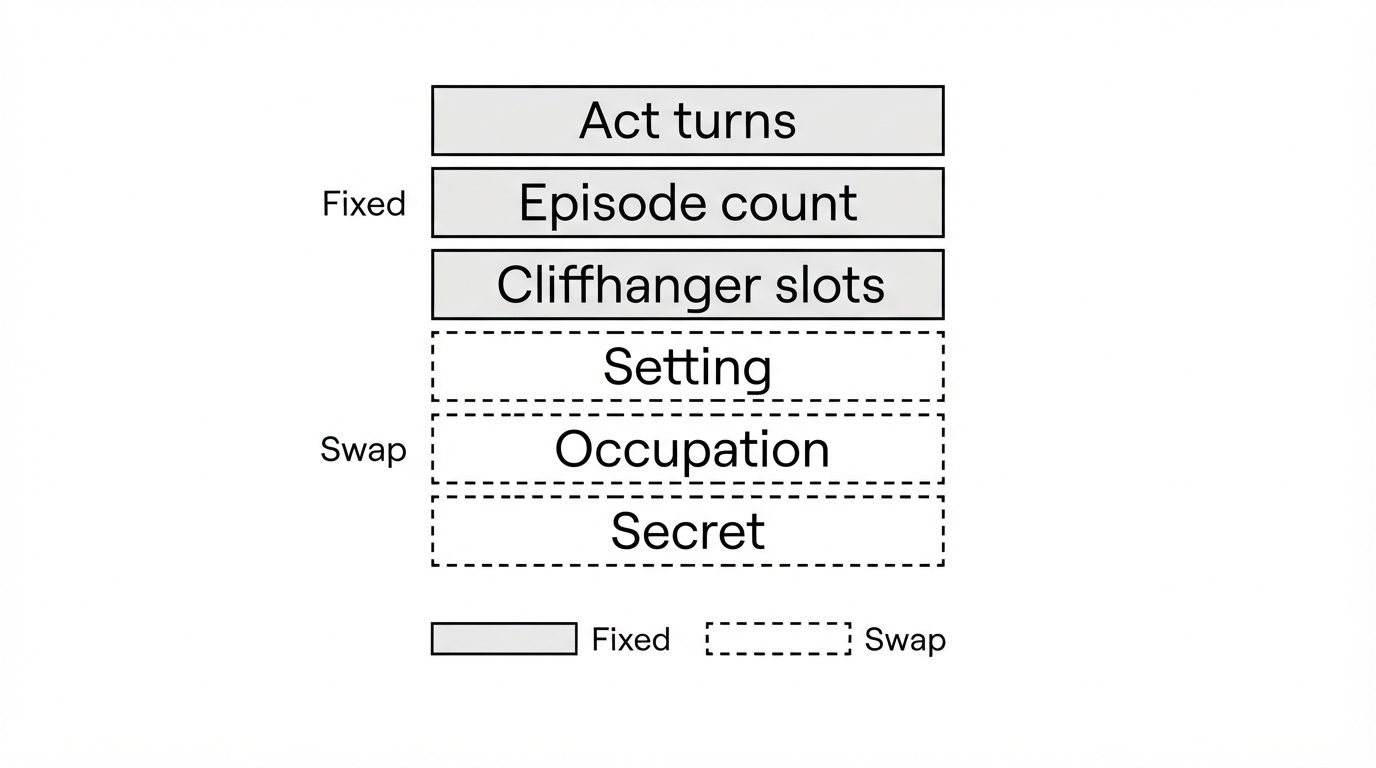
A template becomes dangerous when every part of it gets copied. Three parts should stay and three must change per title.
Staying: turn positions, episode count, and cliffhanger placement. These are the timing frame, and changing them without reason usually makes a title's rhythm feel wrong.
Changing: setting, character occupation, and the secret at risk. These are the content, and this is where one title differs from another.
If two of your titles use the same frame and audiences still experience them as different stories, your template is being used correctly. If they feel similar, one of the three replaceable parts was probably copied along with the frame.
Fitting the same frame to different genres
The same three-act frame works across genres; what changes is what fills the turns.
In romance, the episode four decision is usually a commitment made before either party is ready, and the episode eight low point is trust collapsing. In thriller, episode four is a decision that makes the character a target, and episode eight is the loss of their last protection.
In horror, the same frame works by swapping social pressure for survival pressure, and the low point is usually the realisation that the rule the character trusted was wrong. In comedy, the turns remain but the price becomes embarrassment rather than danger.
Choosing the genre before filling the frame saves considerable revision, because genre determines scene length and which kind of cliffhanger feels natural.
When a template is constraining rather than helping
There is a point where a template stops being useful, and the signs are clear.
If you are writing a scene only because the template says one belongs there, rather than because the story needs it, the template has taken over. Delete the scene and see whether anything is missing.
If a character makes a decision that makes no sense for them in order to satisfy the turn at episode four, move the turn. The timing frame exists to serve the story, not the reverse.
If your last two titles feel similar despite different settings and characters, you are probably copying the sequence of events rather than only the frame. Change the primary source of conflict and the same frame will produce something that feels new.
How to use this theme in production
Choose the genre first
Genre determines scene length and which kind of cliffhanger feels natural.
Mark the turns
Episodes 4, 8, and 12. This is the timing frame and should not move without reason.
Replace setting, occupation, and secret
These three are what distinguish one title from another.
Fill the other eight episodes
Not as hard as the turns. The contrast is what makes the turns register.
Use the beat template while writing
Structure template once per title; beat template repeatedly per episode.
Delete scenes that only satisfy the template
If nothing is missing afterwards, it was not needed.
Câu hỏi thường gặp
What is a drama template and why use one?
A frame that sets how many episodes there are, where the turns fall, and how intensity climbs. Its value is not re-deciding the same structural questions on every title, so your effort goes into content instead.
How many episodes does a standard template cover?
Twelve, divided into three acts of four. For longer titles the pattern repeats: three large turns remain in place with smaller turns between them.
Where do the turns fall?
Episode 4 closes act one with a decision that cannot be taken back, episode 8 is the lowest point, and episode 12 is the payment. All three deserve the strongest cliffhangers.
What is the difference between a structure and a beat template?
A structure template governs the whole title and rarely changes. A beat template governs one episode and changes almost every time. Using one for the other's job is the most common mistake.
Do templates make all stories feel the same?
Not if only the frame is copied. Similarity almost always appears when the setting, character occupation, or the secret at risk is copied too. All three must change per title.
Can one template serve different genres?
Yes. The same three-act frame works across genres; what changes is what fills the turns. In romance the low point is collapsing trust, in thriller it is losing the last protection.
Which parts of a template may be changed?
Setting, character occupation, and the secret at risk must be changed. Turn positions, episode count, and cliffhanger placement are better kept, because they set a rhythm that already works.
What if my story needs its turn somewhere else?
Move it. The timing frame exists to serve the story. The clearest sign a turn is misplaced is a character making a decision that makes no sense for them in order to reach it.
May the eight non-turn episodes be quieter?
They should be. If every episode matches the intensity of a turn, the turns stop feeling distinct and the audience loses the rise and fall that makes a serial comfortable to follow.
Which template suits a beginner?
The twelve-episode structure template, because it answers the question that most often stops beginners: how long is this story and what has to happen in the middle.
How do you know a template is constraining the story?
When you write a scene only because the template says one belongs there rather than because the story needs it. Delete the scene; if nothing is missing, it was not needed.
Does a template replace an outline?
No. A template provides the timing frame; an outline fills in what happens inside it. The template answers when something must happen, the outline answers what happens.


Page summary
This section answers the most common questions so you can understand the page context faster before moving to the next creative step.