


Story ideas for short drama: how to produce premises instead of waiting for inspiration
How to find short drama story ideas that do not run out: a premise matrix built from one character, five sources of conflict that always work, and how to split one idea into twelve episodes.
Most creators stall at the idea stage because they are waiting for a perfect sentence to arrive. In practice, premises that work are almost always assembled rather than received.
The recipe is unremarkable: take one character, then add one pressure. A character without pressure produces a description, not a story. A pressure without a character produces an event, not a drama. Together they produce a premise.
Because it is assembly, ideas can be produced on schedule. One thirty-minute session with the method below usually yields five to ten premises worth testing, which is far more useful than one idea waited on for weeks.
The key points on this page
- A simple matrix that produces nine different premises from a single character.
- Five sources of conflict that work across genres: secret, debt, rival, deadline, and loyalty.
- How to test whether an idea has enough fuel for twelve episodes.
- A concrete example of expanding one idea into three acts and twelve episodes.
- Where each idea connects to the genre and theme pages.
Ideas are assembled, not awaited
The most common reason creators stall is waiting for one large idea. But a working premise is a combination, and combinations can be produced deliberately.
Take a character. Add a pressure. That is the whole mechanism. What makes it useful is that both halves are interchangeable, so a single afternoon can generate a queue of premises rather than one fragile idea.
The filtering comes later. At the generation stage the goal is availability of choice, because comparing options is far easier than assessing a single premise standing alone.
The premise matrix: nine stories from one character
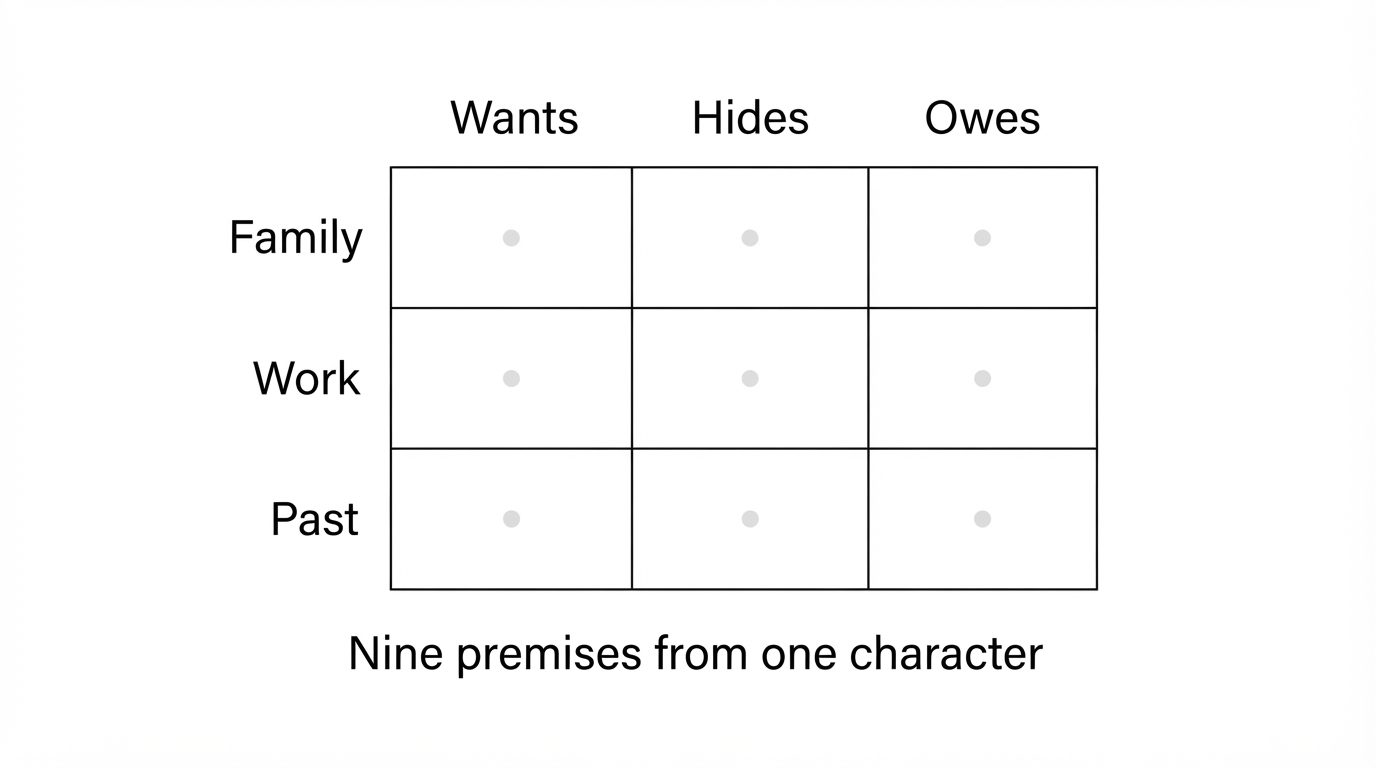
Write one character in the middle, say a young nurse. Then draw a three by three table. The columns are the character's relationship to something: what they want, what they hide, and what they owe. The rows are areas of life: family, work, and past.
Every cell produces a different premise. A nurse who wants something from her family is not the same story as a nurse hiding something at work, and neither is the same as a nurse who owes something to her past.
Fill the nine cells with short sentences without judging them. Filtering happens afterwards. What matters here is making the options exist.
Then read them back and find the cell that makes you want to know what happens next. That reaction is the most honest signal you have before you have an audience.
Five sources of conflict that work in any genre
When the matrix feels stuck, what is usually missing is not creativity but pressure. Five sources work reliably across genres and attach to almost any premise.
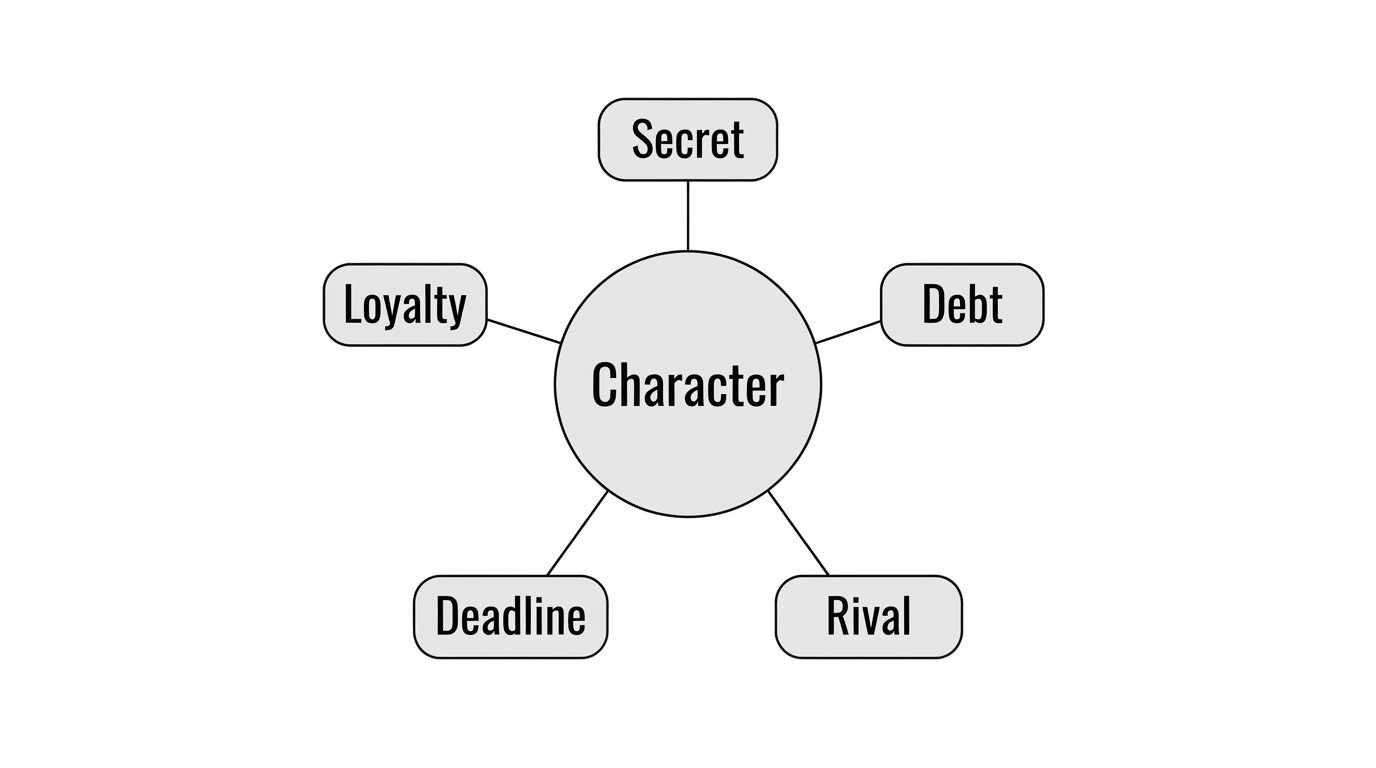
A secret creates the risk of exposure. A debt creates a ticking clock. A rival creates an opponent with reasons of their own. A deadline forces the decision to be made now. Loyalty forces a choice between two things the character values.
Attach one and the story comes alive. Attach two that collide and you have material for dozens of episodes. A secret that must be kept alongside a debt that must be repaid forces repeated bad decisions, and repeated bad decisions are the engine of a serial.
Do not attach all five. Too many pressures leave the audience unsure what is at stake, and the story feels busy without feeling urgent.
Test whether your idea has fuel for twelve episodes
Ideas that feel strong in your head often run out of air by episode six. Three quick questions predict it before you write anything.
First: what happens if the lead does nothing? If the answer is nothing, there is no pressure. Second: who is most harmed if the lead succeeds? If nobody, there is no opponent. Third: what does the lead hide from the person closest to them? If nothing, there is no material for the second act.
An idea that clears all three can almost always be carried to twelve episodes. An idea failing one can still be rescued, but it is cheaper to fix now than after six episodes are produced.
One extra warning sign: if your summary takes more than three sentences for someone else to understand, the premise is probably too complex for the vertical format.
From one premise to twelve episodes
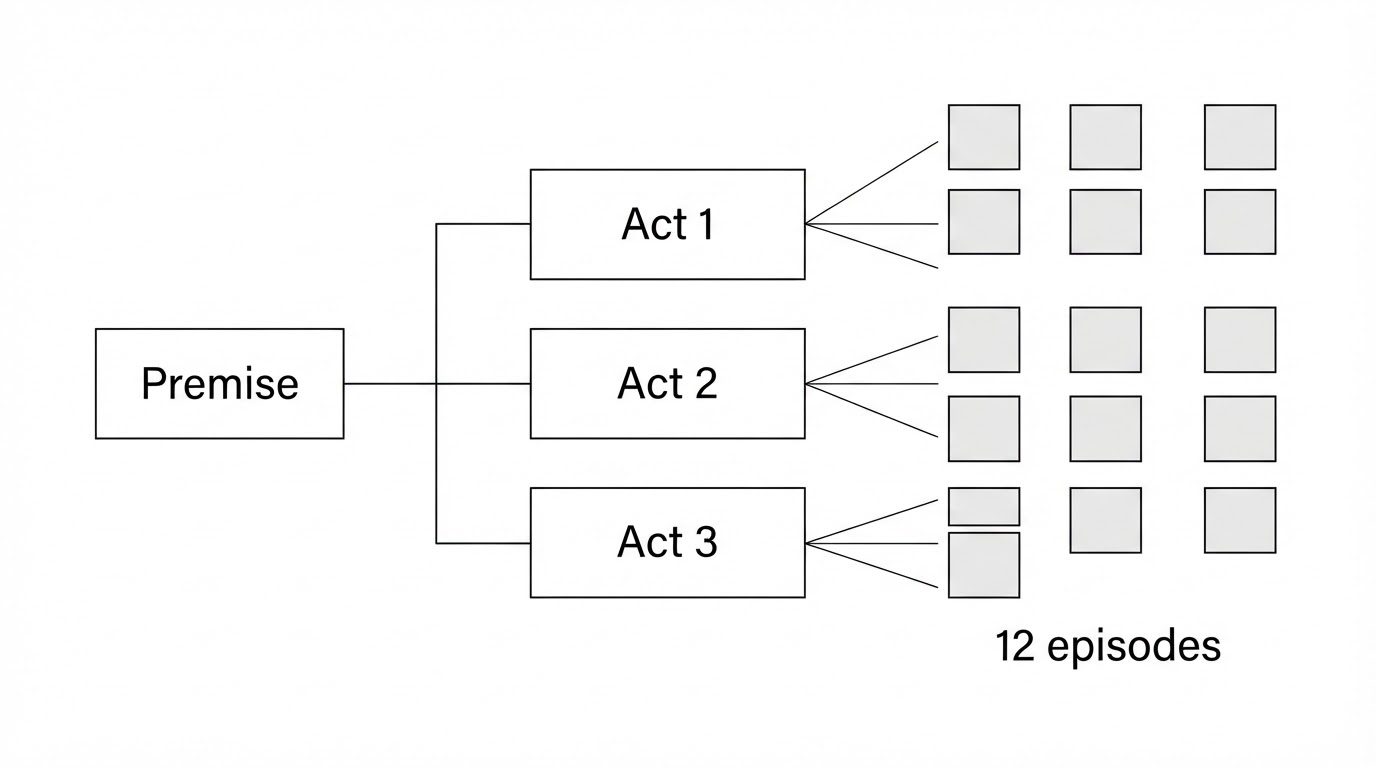
Once a premise clears the test, split it into three acts. The first act introduces the pressure and ends when the lead makes a decision that cannot be taken back. The second act worsens things through the consequences of that decision. The third act forces the lead to pay or accept the price.
Divide each act into four episodes, giving twelve. Write one sentence per episode describing what changes. If any episode's sentence feels forced, that is where the story is short of material, and it is far easier to fix now.
Pay particular attention to episodes four and eight, the transitions between acts. These are where viewers most often decide to stop or continue, so both deserve the strongest cliffhangers.
These twelve episodes are a map, not a script. Full scripts follow one at a time, once the overall direction is clear.
Storing ideas so they neither vanish nor repeat
Productive creators almost always keep one place for ideas rather than relying on memory. The format does not matter; what matters is recording three things per idea: character, pressure, and one opening scene you can picture.
The opening scene is the part most often skipped and the most useful later. A premise without one often reads flat when revisited a month on, even though it felt alive when written.
Review the list before starting a new title. Besides saving time, the habit prevents a problem few notice: rewriting the same premise with different character names. Loyal viewers spot that pattern faster than you would expect.
How to use this theme in production
Pick one character
Occupation and age are enough. Other details follow once the premise is chosen.
Fill the three by three matrix
Columns: wants, hides, owes. Rows: family, work, past.
Attach two pressures
Choose two of secret, debt, rival, deadline, loyalty that collide with each other.
Run the three-question test
What if they do nothing, who is harmed if they succeed, what do they hide.
Split into three acts
End act one on a decision that cannot be taken back.
Write one line per episode
Twelve lines. Episodes four and eight carry the strongest cliffhangers.
คำถามที่พบบ่อย
How do you find story ideas when you are stuck?
Do not look for one big idea. Take a character and fill a three by three matrix of what they want, hide, and owe against family, work, and past. Those nine cells almost always produce two or three premises worth testing.
What is the difference between an idea, a premise, and a synopsis?
An idea is raw material, such as "a drama about a nurse". A premise adds pressure and stakes in one sentence. A synopsis describes the sequence of events. For short drama you need the premise first, not the synopsis.
How long should a premise be?
One sentence naming the character, the pressure, and what is lost on failure. If it takes more than three sentences for someone else to understand, it is probably too complex for the vertical format.
How do you know an idea is strong enough for a serial?
Answer three questions: what happens if the lead does nothing, who is harmed if they succeed, and what do they hide from the person closest to them. An idea with answers to all three almost always reaches twelve episodes.
Which source of conflict is easiest for beginners?
A secret and a deadline. Both are understood without explanation, and both create risk in every scene without requiring extra locations or characters.
Is it acceptable to use a common premise like a contract marriage?
Yes, and it is often an advantage. A familiar premise saves explanation time so viewers can enter immediately. What differentiates a title is not the premise but why the character stays and the turn nobody predicted.
How many ideas should you prepare before writing?
Five to ten premises, then pick one. Comparing several options is far easier than judging a single premise alone, and the rest become the queue for your next title.
How do you avoid a story that circles in the middle?
Make sure every episode changes something: new information, a shifted relationship, or raised stakes. If an episode can be deleted without affecting the next one, that is where the story is circling.
How many episodes should you plan up front?
Twelve. Long enough to prove the premise has fuel, short enough to revise in one working session before production starts.
What makes a plot twist satisfying rather than arbitrary?
A twist that works changes the meaning of what already happened rather than adding new events. Viewers should be able to look back and see the clues were there from the beginning.
How should you store ideas so they stay useful?
Record three things per idea: character, pressure, and one opening scene you can picture. The opening scene is the part most often skipped and the one that decides whether the idea still feels alive weeks later.
Does an idea have to be fully original?
No. Genres work precisely because their patterns are recognised. What needs to be original is the specific reason your character stays and how they pay the price, not the general shape of the story.


Page summary
This section answers the most common questions so you can understand the page context faster before moving to the next creative step.