


What is Genre "Short Drama Romance" in Microdrama?
A romance genre guide for vertical short drama: how closeness rises and falls across twelve episodes, four subgenres and the pressure each carries, and the four steps to a payoff that lands.
Romance that works does not raise closeness continuously. It raises, holds, then drops, and it is the drop that makes the next rise register. A flat romance serial is almost always one where the characters never genuinely retreat.
Romance is the most searched genre in the vertical format and the one that most often fails. Not because audiences tire of it, but because many titles treat romance as closeness that keeps increasing. What actually holds viewers is not closeness; it is the distance that has not yet closed.
In a minute or two per episode there is no room to build feeling through long conversation. What is available is situation: who stands nearer, who holds back a line, who leaves first. Romance that works in this format is romance you can read with the sound off.
This page covers the part that decides production: managing the rise and fall of closeness across twelve episodes, which subgenre suits which pressure, and how to build a payoff so the final episode feels paid for rather than merely finished.
Why Genre "Short Drama Romance" matters for short drama production
In practice, a strong genre helps viewers make a fast decision: whether the series feels relevant, whether the conflict is interesting, and whether the next episode is worth watching.
That is why genre is not just a catalogue label. It filters tone, dialogue rhythm, conflict shape, visual style, and the type of cliffhanger that will feel most effective.
- Viewers understand within three seconds that this is a story about two people and one obstacle.
- Writers gain a reason to reject charming scenes that neither add nor remove distance.
- Visual teams can lock camera distance and blocking early, because romance speaks through bodies more than dialogue.
- Thumbnails and titles are easier to direct, because an obstacle is easier to depict than a feeling.
- Revision drops because every scene can be tested with one question: does this add or remove distance?
How to read this genre before writing episodes
This section covers story direction, opening hooks, conflict pressure, and how to keep characters feeling human.
The closeness curve: rise, hold, fall
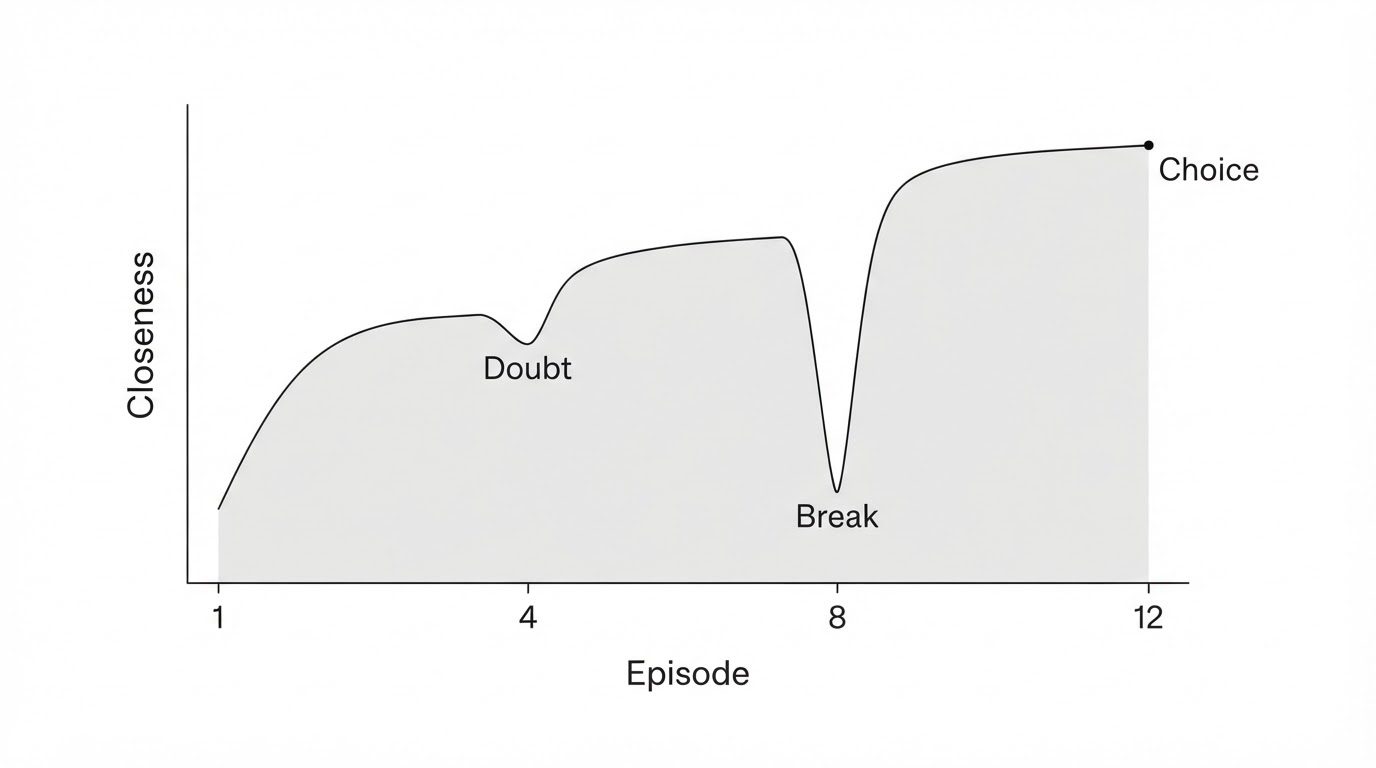
Picture the closeness between two characters as a line across twelve episodes. The interesting line is not a straight climb but one that rises in stages with two deliberate drops.
The first drop is usually doubt, arriving around episode four: one character realises something that makes them withdraw. The second is deeper and lands around episode eight: trust collapses, and both return to a point lower than where they started.
That second drop is what writers most often avoid because it is painful to write. It is also what gives the closing episodes weight. Without a lowest point, a confession at the end reads as a continuation rather than a decision.
Four subgenres and the pressure each carries
Romance subgenres are not merely settings. Each carries one kind of pressure that shapes the conflict.
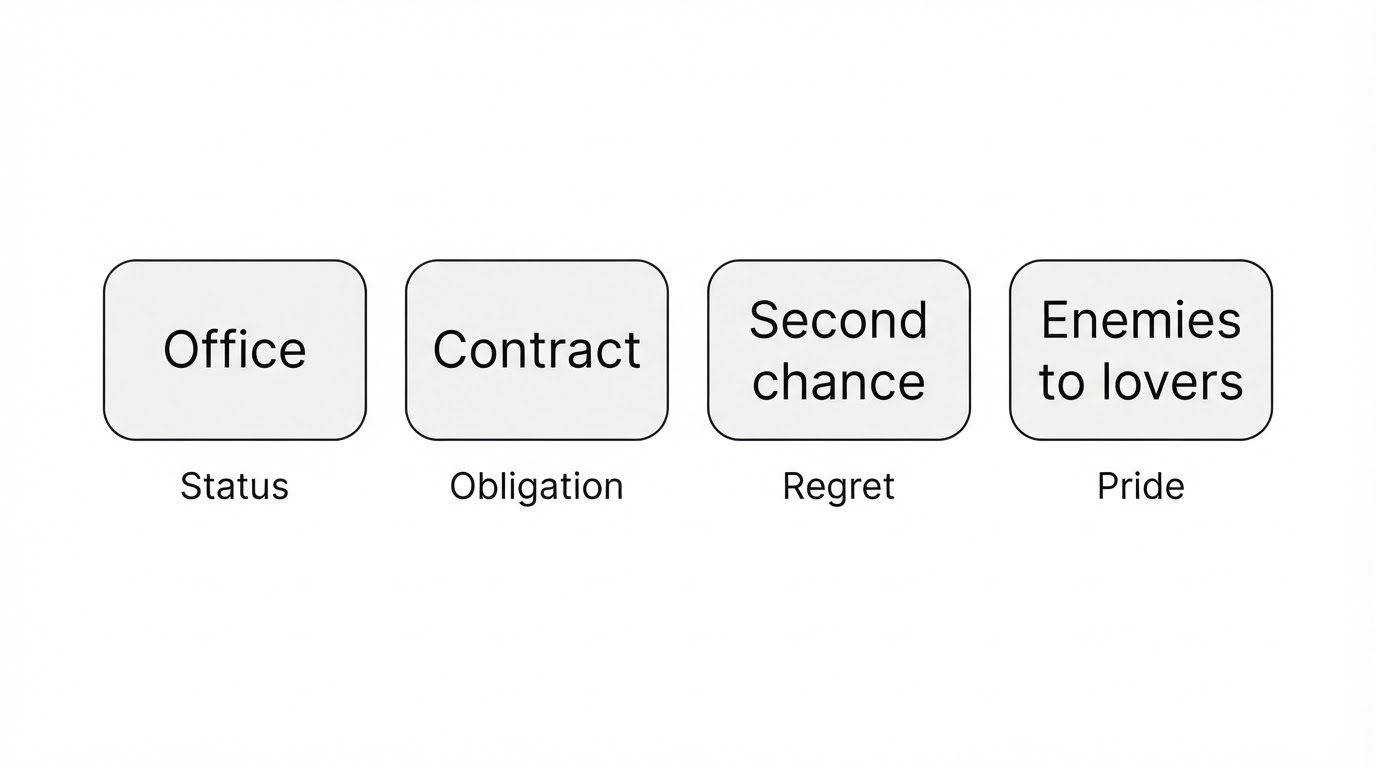
Office romance works through status: an unequal relationship, career risk, and other people watching. Contract marriage works through obligation: two people bound before they want each other, so every moment of closeness breaks an agreement.
Second chance romance works through regret: both have already failed once, and every step forward carries the memory of how it ended. Enemies to lovers works through pride: admitting feeling means admitting the first judgement was wrong.
Pick one as the primary home. You can borrow elements from the others, but the main pressure must be singular, because viewers can hold only one large question at a time in this format.
Four steps to payoff
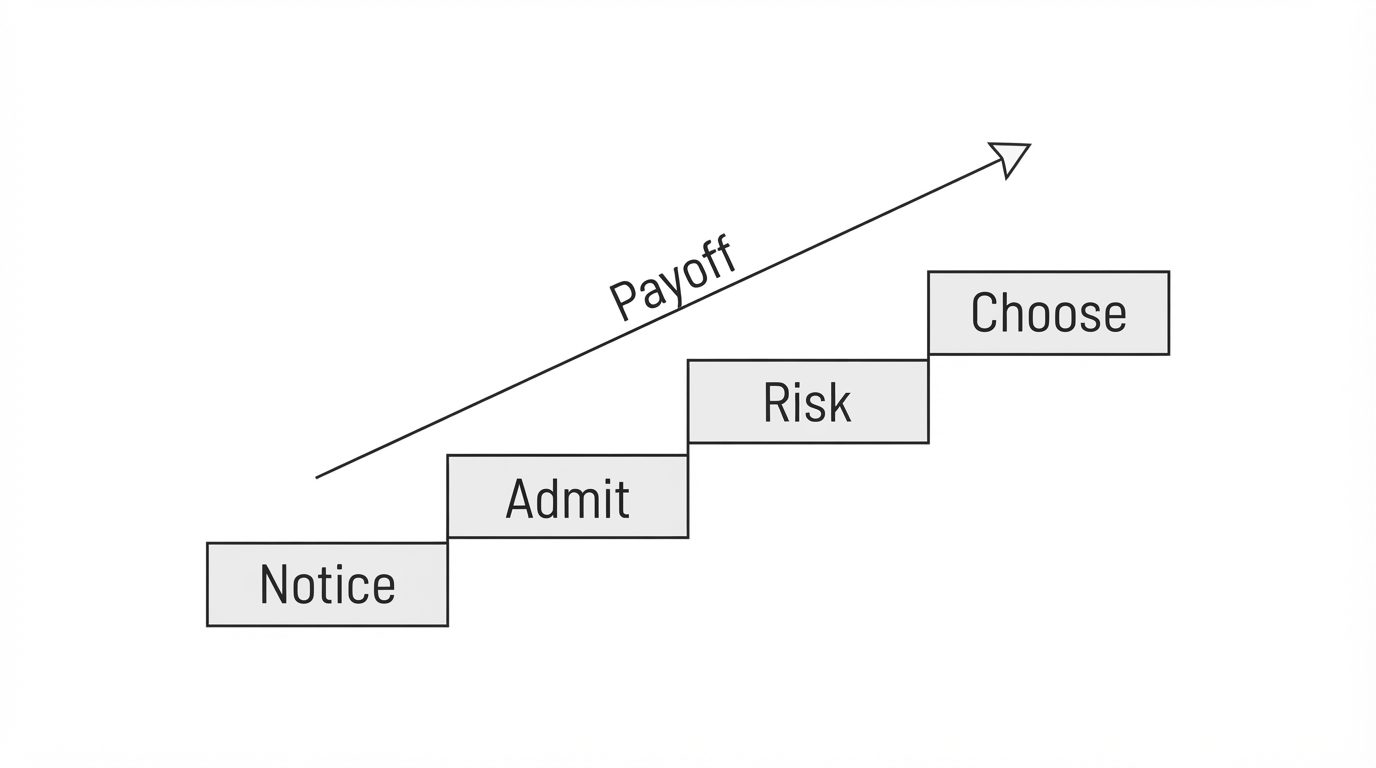
Romance payoff rarely works if it jumps straight to a confession. It usually needs four steps: notice, admit, risk, choose.
Noticing is the moment a character knows their own feeling but only to themselves. Admitting is saying it to someone, often not the person concerned. Risking is doing something that could cost them. Choosing is closing off the alternative.
Many serials stop at the second step and wonder why the ending feels thin. A confession without sacrifice is only information; the audience worked it out by episode two.
The fourth step is the one most often forgotten. Choosing means something is left behind, and viewers need to see what is left behind for the choice to feel valuable.
Why refusal beats agreement
Across the first ten episodes, every time one character agrees to something the story loses a little energy. Every time one refuses, it gains some.
Refusal does not have to mean an argument. It can be a delayed answer, a line not quite said, or help declined politely. What matters is that distance remains.
A practical rule: until around episode ten, each scene of closeness should be followed by one that separates. Not to torment the audience, but to keep the question open.
After episode ten, invert the rule. In the final two episodes refusal only tires viewers, because they have paid long enough to deserve an answer.
Mistakes that leave chemistry flat
Dialogue that is too honest too early. Once a character states exactly what they feel in episode three, there is nothing left to wait for. Let them talk about something else while meaning that.
No real obstacle. An obstacle like "we are busy" or "the timing is wrong" cannot be seen on screen. Obstacles that work have a shape: a third person, a document, a position, or a promise made to someone else.
Both characters waiting. If nobody moves, the story stops. One has to take a risk first, and it is usually more interesting when it is the one who logically has most to lose.
Charming scenes without consequence. Scenes that are pleasant to write often change nothing. Test each one: after this, what is different between them?
Key points to remember
The obstacle matters more than the feeling. Viewers can guess the couple will end up together and they do not mind. What they want to know is the price of getting there, and that price is set by how real the obstacle is.
The most satisfying payoff is usually a choice that costs the character something visible. A confession without a cost is information; the audience already had it by episode two.
- Office romance, Contract marriage, Second chance, Enemies to lovers
- warm feeling, longing, and relationship conflict
- an obstacle with a visible shape
- a confession, a sacrifice, or a choice that closes the pull between them
- Vertical, 1–2 minutes per episode
How to use this genre in production
Decide the obstacle first
Before writing feeling, decide what stands in the way. It must have a shape you can film.
Pick one subgenre as home
Status, obligation, regret, or pride. One main pressure only.
Mark the two drops
Doubt around episode four, collapsing trust around episode eight.
Alternate closer and further
Until episode ten, each scene of closeness is followed by one that separates.
Build the four payoff steps
Notice, admit, risk, choose. Do not stop at the second.
Test every scene
After this scene, what is different between them? If nothing, it is not needed yet.
Frequently asked questions
What holds viewers in a short drama romance?
Not closeness but the distance that has not closed. Viewers already assume the couple will end up together; what they want to know is the price of getting there.
How should closeness rise and fall across a serial?
Rise in stages with two deliberate drops: doubt around episode four and collapsing trust around episode eight. Without a lowest point, the final confession reads as continuation rather than decision.
Which romance subgenre is easiest for beginners?
Contract marriage, because the obstacle already has a shape from episode one and needs no lengthy explanation. Viewers immediately understand that every moment of closeness breaks an agreement they can see.
Why does chemistry feel flat despite charming dialogue?
Usually because the characters are too honest too early. Once feeling is stated plainly in episode three, nothing remains to wait for. Let them discuss something else while meaning that.
How often should characters refuse each other?
Until around episode ten, balance each scene of closeness with one that separates. After that the rule inverts, because viewers have paid long enough to deserve an answer.
What kind of obstacle works in the vertical format?
Obstacles with a shape that can be seen: a third person, a document, a position, or a promise made to someone else. Obstacles made of feelings or bad timing cannot be read in seconds.
How do you build a satisfying romance payoff?
Move through four steps: notice, admit, risk, choose. The strongest payoff is a choice that visibly costs the character something, because that is the proof the feeling is real.
Which character should move first?
The one who logically has most to lose if refused. The larger risk makes the move mean more, and forces the other to give an answer that cannot be postponed.
How many episodes suit a romance title?
Twelve is enough to test whether the obstacle has fuel. For a full title, many vertical romance serials run between forty and eighty episodes, repeating the rise and fall pattern.
Is a third person always necessary?
Not always, but it is the cheapest way to make an obstacle visible. Alternatives are obligations with a shape, such as a contract, a family debt, or a position that would be lost.
How do you test whether a romance scene is needed?
Ask what is different between them afterwards. If the distance neither grew nor shrank, the scene was pleasant to write but does not move the story.
What should you read after this?
Move to a theme with more concrete conflict: the CEO theme for status pressure, contract marriage for forced closeness, or the love triangle theme for an obstacle shaped like a third person.


Page summary
This section answers the most common questions so you can understand the page context faster before moving to the next creative step.