


What is Genre "Short Drama Action" in Microdrama?
An action genre guide for vertical short drama: how many beats per episode, four steps of threat escalation, and how to build action in a single room without a stunt team.
Action is not about how much movement there is but how fast the character's position deteriorates. Dull action serials are almost always ones where characters move a great deal and are never genuinely cornered.
Action in the vertical format faces a problem that wide formats do not: the screen is too narrow to show two bodies moving at once. A fight that reads as spectacular in a cinema becomes confusion on a phone, because viewers cannot tell who is hitting whom.
The solution is not less action but a different way of delivering it. On a narrow screen, action is read through reaction and consequence: a face absorbing pain, a hand shaking on a door, an object falling. All of those read clearly in a vertical frame; full choreography does not.
This page covers action from the perspective of a small production: how much must happen per episode, how to raise the threat in stages, and how to build something that feels dangerous without a large location or a stunt team.
Why Genre "Short Drama Action" matters for short drama production
In practice, a strong genre helps viewers make a fast decision: whether the series feels relevant, whether the conflict is interesting, and whether the next episode is worth watching.
That is why genre is not just a catalogue label. It filters tone, dialogue rhythm, conflict shape, visual style, and the type of cliffhanger that will feel most effective.
- Viewers know within two seconds that something is dangerous, and danger is the fastest genre promise to read.
- Writers get a concrete target for how much must happen per episode instead of a feeling of enough.
- Visual teams can design in one room with three positions, keeping cost and time under control.
- Thumbnails are easy because action has a clearly shaped peak moment.
- Every scene can be tested: is the character in a worse position after this?
How to read this genre before writing episodes
This section covers story direction, opening hooks, conflict pressure, and how to keep characters feeling human.
Beat density: action needs double
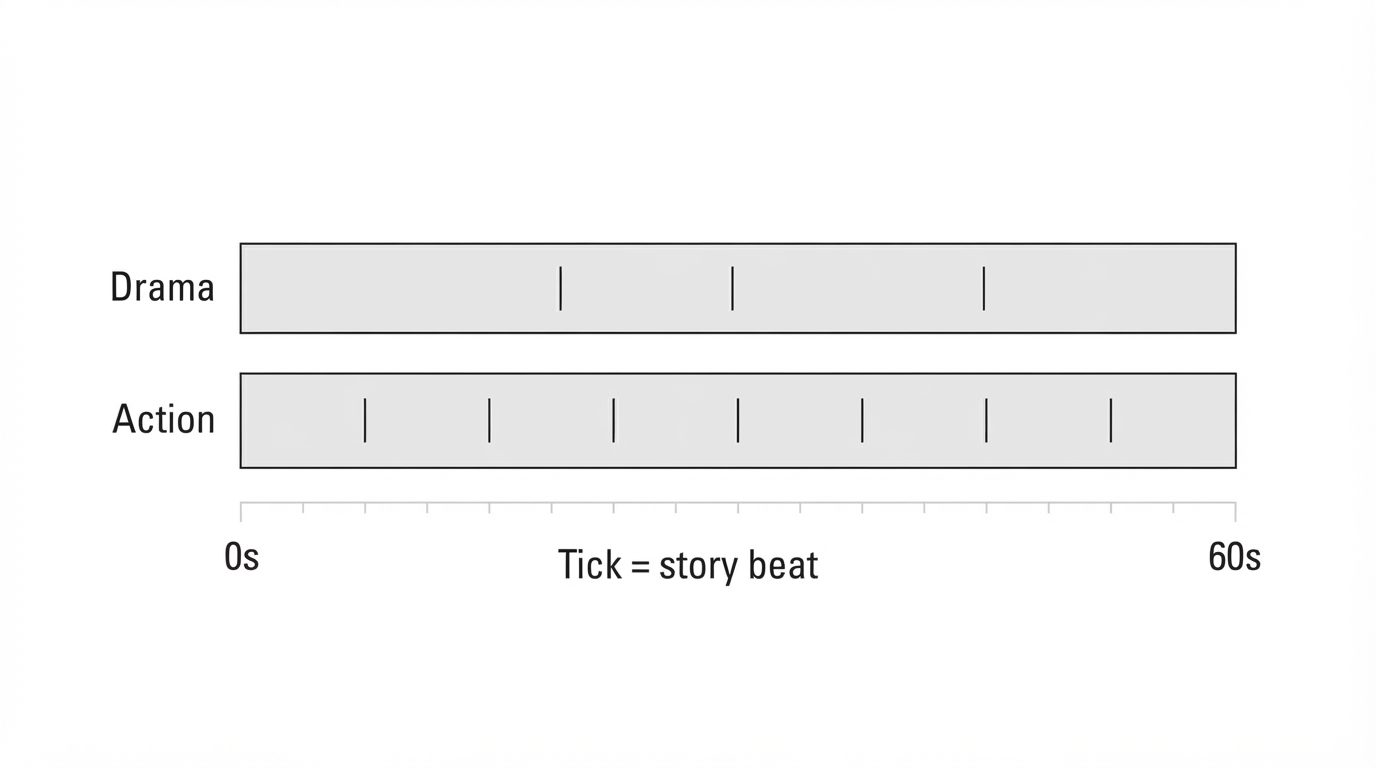
An ordinary drama episode runs comfortably on three events that change something. Action needs roughly twice that in the same runtime.
The reason is simple: the genre promise of action is movement, and an audience that came for movement feels every second without an event as slowness. Dialogue scenes that feel normal in another genre feel like an advert break here.
Events do not have to be fights. Finding a locked door, losing a weapon, or realising someone else is in the room all count. What matters is that the character's position changes.
A practical benchmark: if ten consecutive seconds pass without the character's position changing, viewers begin scrolling. Check your script with a stopwatch rather than a feeling.
Four steps of threat escalation
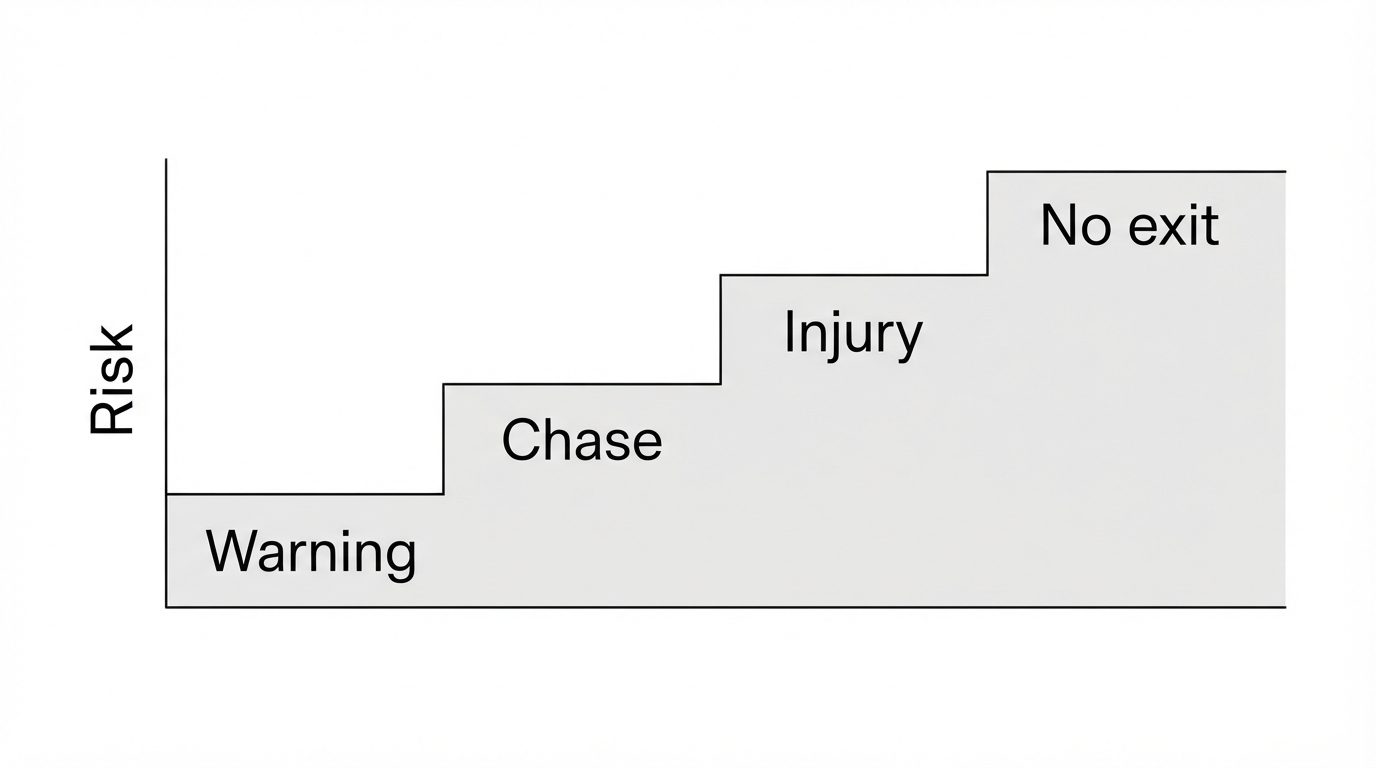
A threat that arrives at maximum in episode one leaves nowhere to climb. A more durable shape uses four steps: warning, chase, injury, no exit.
A warning is danger becoming visible without touching the character: a message, a shadow, a car slowing. A chase is danger moving toward them while they can still run.
Injury is the point where the character pays a physical price for the first time. This is the step most often skipped, and it is what makes viewers believe the risk is real. After a character is hurt, every subsequent scene becomes more tense without extra effort.
No exit is when the options run out. This is where the large decision gets made, and where an action payoff usually lands.
Action inside a single room
Small productions often avoid action because they imagine large locations and stunt teams. In fact the most tense scenes in the vertical format almost always happen in confined space.
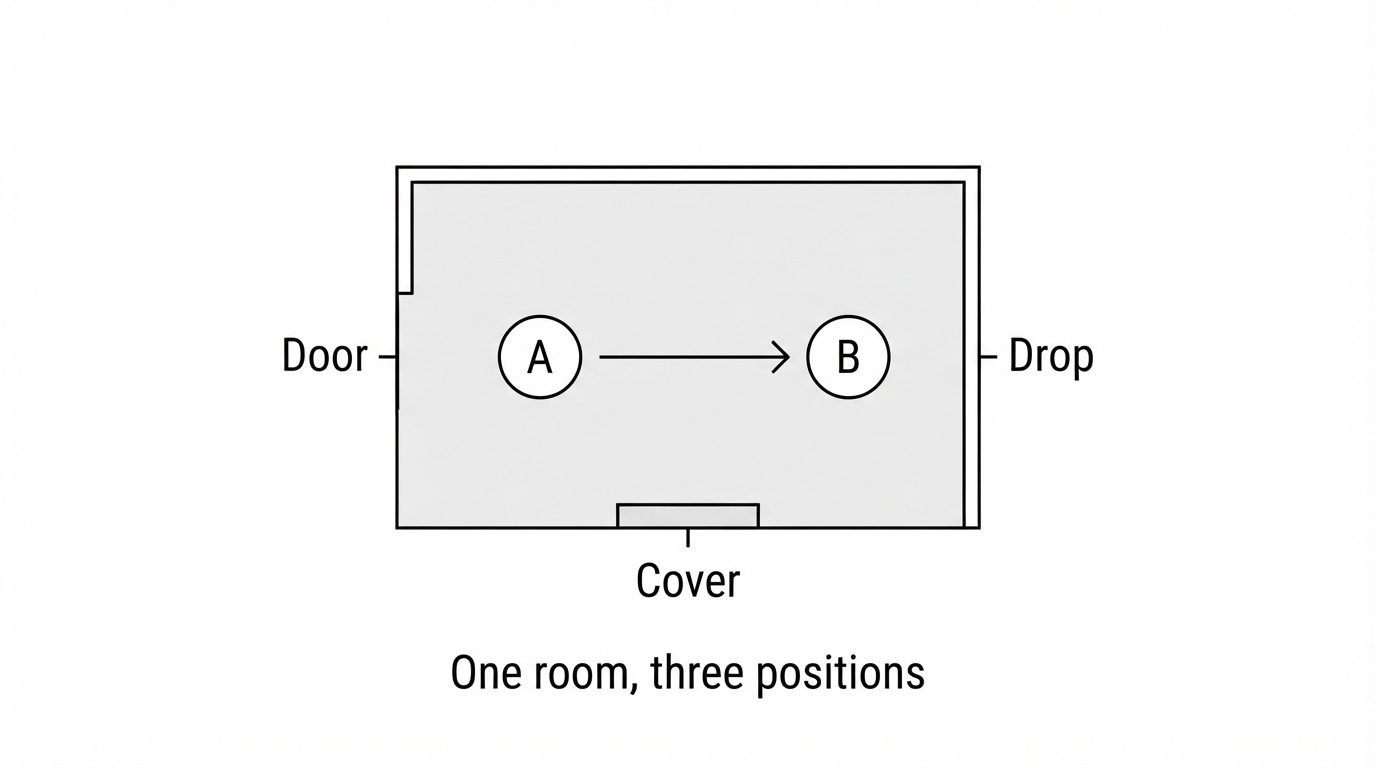
All you need is three positions: a way in, somewhere to take cover, and somewhere something can fall or break. Those three give you everything required to stage a miniature chase in one room.
Confined space is also visually advantageous. A 9:16 frame holds one body well and two with difficulty, so close quarters are easier to shoot than open ones.
Use sound to extend the room. Footsteps outside frame, a door opening at a distance, or breathing close to the microphone create danger that never has to be shown.
Consequence beats choreography
On a screen the width of a palm, viewers cannot follow a sequence of blows. What they register is before and after: who is standing, who is not, and what is broken.
So production time is better spent designing outcomes than movements. One injury still visible three episodes later provides free tension in every scene that follows.
Consequences need not be physical. Losing a phone, losing a witness, or losing a safe place work just as well and cost far less to produce.
A practical rule: every action scene must leave behind at least one thing that cannot be restored. If everything returns to normal next episode, the scene was decoration.
Mistakes that make action busy but not tense
Too many people on screen. In a vertical frame, three bodies is already enough for viewers to lose track. Two characters with a threat outside frame is almost always more tense.
A lead who is never hurt. If the protagonist always emerges without a scratch, viewers stop believing the danger is real and every later scene loses weight.
Action without a clear objective. Viewers need to know where the character is trying to get to or what they are trying to reach. Without an objective, a chase reads as movement.
Music taking over. Tense music running through an entire episode trains the ear and erases the difference between calm and dangerous scenes. Leave silence for the tensest moment.
Key points to remember
On a narrow screen consequence beats choreography. One injury visible across three episodes is more tense than three fights that leave no trace.
The payoff has to feel physical and decisive, but what makes it satisfying is the price paid to win rather than the winning itself.
- Bodyguard romance, Crime revenge, Spy thriller
- adrenaline, pressure, and sharp movement
- a threat that escalates in four steps
- a duel, a rescue, or the fall of the most dangerous figure
- Vertical, 1–2 minutes per episode
How to use this genre in production
Count events per episode
Target roughly double ordinary drama. Check with a stopwatch, not a feeling.
Build four escalation steps
Warning, chase, injury, no exit. Do not skip the injury step.
Design one room with three positions
A way in, somewhere to take cover, somewhere something can fall.
Set a consequence per scene
Every action scene leaves one thing that cannot be restored.
Limit bodies in frame
Two characters with a threat outside frame reads better than three inside it.
Leave silence
Constant tense music erases the difference between calm and dangerous.
Frequently asked questions
Does the action genre suit vertical format?
It does, but the delivery has to change. A narrow screen cannot hold full choreography, so action is read through reaction and consequence: a face absorbing pain, an object falling, a hand shaking.
How many events does an action episode need?
Roughly double ordinary drama in the same runtime. A practical benchmark: if ten consecutive seconds pass without the character's position changing, viewers begin scrolling.
How do you make action scenes without a stunt team?
Build in confined space with three positions: a way in, somewhere to take cover, and somewhere something can fall. Confined space is easier to shoot in a 9:16 frame than open space.
Why do my fight scenes look confusing?
Usually too many bodies in frame. In vertical format three is already enough for viewers to lose track. Reduce to two and move the third threat outside the frame.
Should the lead character get hurt?
At least once. A protagonist who always emerges without a scratch makes viewers stop believing the danger is real, and every scene afterwards loses weight.
How do you raise the threat without running out of material?
Use the four steps: warning, chase, injury, no exit. Starting at maximum threat in episode one leaves nowhere to climb for the rest of the title.
Do consequences have to be physical injuries?
No. Losing a phone, a witness, or a safe place works just as well and costs far less to produce. What matters is that something cannot be restored.
How should music be used in action?
Leave silence for the tensest moment. Tense music running through the whole episode trains the ear and erases the difference between calm and dangerous scenes.
Which action subgenre is easiest to produce?
Bodyguard, because the conflict happens in enclosed space with a small cast. It also leaves room for chemistry, giving viewers a reason to stay between action scenes.
How do you build an action hook in three seconds?
Show a threat already in motion rather than one being prepared. A hand pulling someone out of frame, a door being forced, or a character already running beats any setup.
How long should an action scene be?
Shorter than feels comfortable while writing. Vertical action rarely needs more than twenty seconds; the rest is better spent on consequence, because consequence makes the next action feel risky.
What should you read after this?
The revenge theme for the motive most often used in action, or the viral tips page to make sure the first three seconds genuinely hold viewers.


Page summary
This section answers the most common questions so you can understand the page context faster before moving to the next creative step.